Due to the installation of EMIR on the GTC Nasmyth A focus were CanariCam was originally located, the instrument was dismounted and went through a series of improvements. Among other things, the old cooling sistem was replaced with a new one. Then, on December 2019, the instrument was relocated to one of the 4 folded Cassegrain foci available at GTC (folded Cassegrain E). From the user point of view, the instrument remains unchanged and the expected performances should remain the same. The format of the fits files is as before, thus if you have your own reduction scripts they should still work. Differences, if any, could be expected only in polarimetry mode, because in the new focus the pupil position with respect to the detector has changed.


 Instrumental Sensitivity
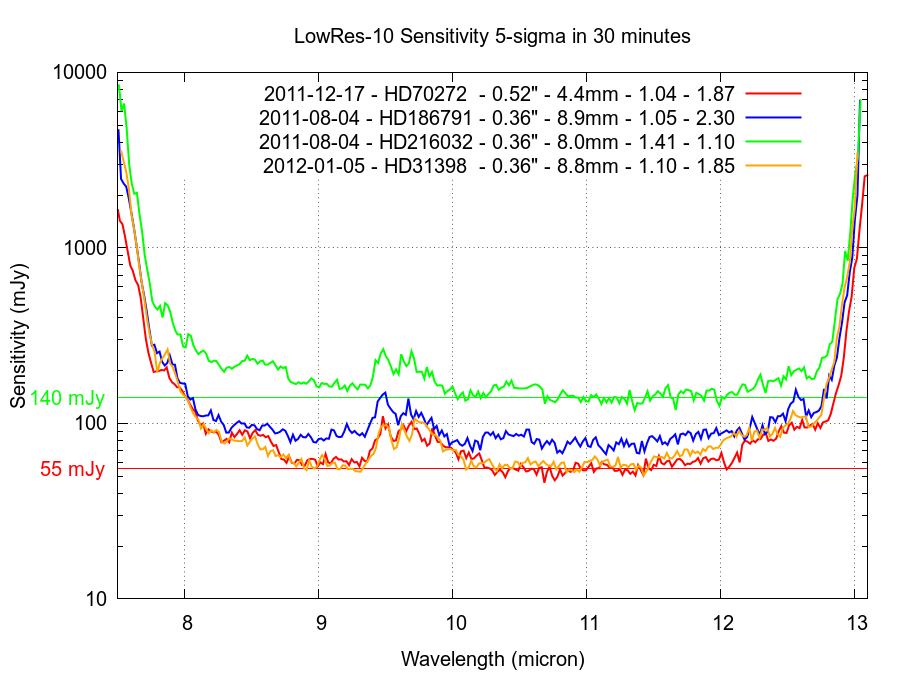
The instrument global performance and sensitivity remain unchanged. Details on the IQ and chopping-nodding behaviour can be found here, while imaging/spectroscopy sensitivities are identical to the ones previously achieved, already listed here (see also Figure below).
Istrumental polarization
A number of stars were observed on the night of 5th and 6th March 2020, in order to measure the level of instrument polarization and its position angle (PA). Standard chop-nod images in Si4-10.3 filter were obtained. From the analysis of these data it was found that the level of instrumental polarization is fully consistent with the pre-upgrade value of around 0.8 percent, which is a good confirmation that the global performances of the instrument did not changed.
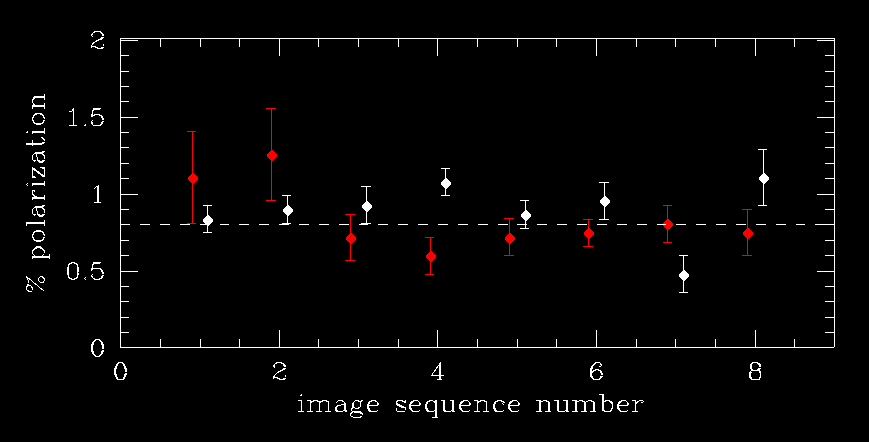
The polarization position angle, as expecteed, did change because most of the instrumental polarization is due to the 90 degrees reflection on M3, and on its new position on the folded Cassegrain focus the instrument "sees" M3 from a different orientation. The advantage of the current configuration is that now the instrument-M3 relative position never change (at the Nasmyth focus it did change with elevation). Actual measurements give the following simple relation for the instrumental polarization position angle (from detector Y direction):
where RMA is the instrument rotator position (FITS header keywords ROTATOR1 and ROTATOR2). This is consistent with the old value of PA=-(RMA+Elevation)-29.6, because now M3 is seen as when elevation was equal to 90 degrees, and the instrument has been mounted upside down, adding a 180 degrees term (see figure).
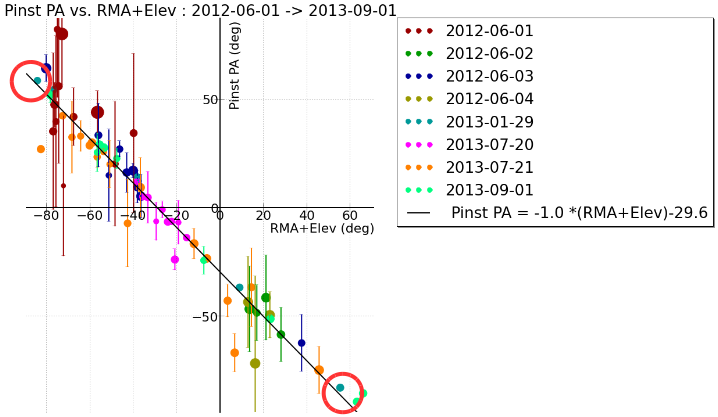
Thus the old relation PA= -(RMA+Elev.)-29.6 transforms to PA=-(RMA+90)-29.6+180= 60.4-RMA. The two big red circles indicate the expected approximate position angle for the instrumental polarization, which fully agrees with measurements
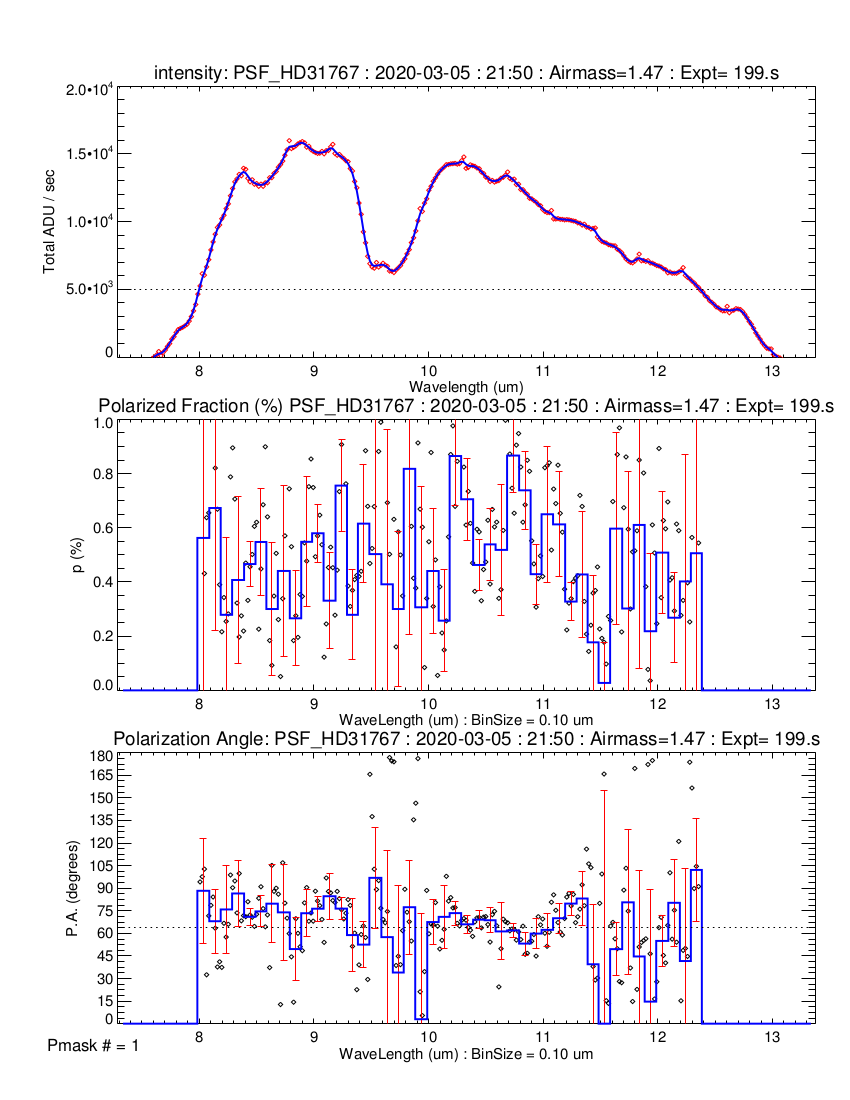
In the next Figure an example of spectropolarimetry observation of the non polarized standard star HD31767 is shown. The intensity of the instrumental polarization is found at around 0.5%, consistent with what is observed in imaging mode. The polarization position angle is also around 60 degrees, again consistent with imaging mode.
Canaricam contact persons at GTC
| contact | email @ gtc.iac.es |
| Riccardo Scarpa - main contact | riccardo.scarpa |
| Daniel Reverte | daniel.reverte |
Useful Documents
- CanariCam Astronomers User Manual
- PWV forecasting at ORM: quantifying the best values to observe with Canaricam
- http://adsabs.harvard.edu/abs/2001hsa..conf..395P
- http://adsabs.harvard.edu/abs/2008SPIE.7014E..83L
- http://adsabs.harvard.edu/abs/2008SPIE.7014E..79M
- http://adsabs.harvard.edu/abs/2008SPIE.7014E..25T
- http://adsabs.harvard.edu/abs/2007RMxAC..29....9P
- http://adsabs.harvard.edu/abs/2005RMxAC..24....7P
- http://adsabs.harvard.edu/abs/2005ASPC..343...38P
- http://adsabs.harvard.edu/abs/2003SPIE.4841..913T
Acknowledgements
We thanks Chris Wright, Chris Packham, Enrique López, Frank Varosi, and the UF team for the huge help provided during the whole process of upgrade of CanariCam.
Last modified: 30 September 2026


